Be yourself; Everyone else is already taken.
— Oscar Wilde.
This is the first post on my new blog. I’m just getting this new blog going, so stay tuned for more. Subscribe below to get notified when I post new updates.
Be yourself; Everyone else is already taken.
— Oscar Wilde.
This is the first post on my new blog. I’m just getting this new blog going, so stay tuned for more. Subscribe below to get notified when I post new updates.
On June 25, 2009 the worldwide medias announced the sudden death of the King of Pop, Michael Jackson. Not having grown up worshipping his music, I hardly remember this day that was not so peculiar in my young life. Besides the baby-dangling incident, the polemics regarding his alleged pedophilia and the mysterious circumstances surrounding his death, I didn’t know much about the man, the extent of his artistic legacy and even less his humanitarian work. In the years following his death, he remained a mysterious character whose I listened to the most emblematic hits on the radio. My curiosity was piqued much later, around the celebrations of its 60th anniversary. I came to appreciate both the person and the artist, without considering myself as a fan of his music or digging deep into the allegation. In my mind, he had been acquitted and there was no particular reason to question court decisions… until January 25, 2019 as Leaving Neverland dropped as a bombshell at the Sundance Festival. Despite being a strong advocate of the presumption of innocence, I was willing to believe that the allegations were credible and the documentary devastating given its wide approval by the first viewers and critics. However, I was quickly stunned by the lack of skeptical questioning in the media and even more by the vileness of many arguments against Michael Jackson on social networks : on his appearance, his mental state, his eccentricities,… I noticed a wave of articles nicknaming him (Wacko) Jacko, also widely used on social networks. From the first time I heard it, I got the impression that it referred to an animal without knowing that it indeed takes its root from the story of an acrobatic monkey named Jacco Maccacco who was exhibited during animal fights at Westminster in the early 1820’s. I discovered that Jacko had been commonly used to name various monkeys since the 19th century: pet monkeys (i.e. the monkey accompanying the Franklin expedition to Antarctic in 1845), monkeys in urban legends (i.e. the Jacko hoax in the 1880s’) , monkeys in children’s tales (i.e. Jumpo & Jacko Kynkytail: the funny monkey boys in the 1910s’), monkeys in children’s games (i.e. the vintage doll Jacko the monkey by Chad Valley in the 1960’s). Thus, the reminiscence of press articles referring Michael Jackson to Jacko took a strange resonance in my mind. Pure coincidence?

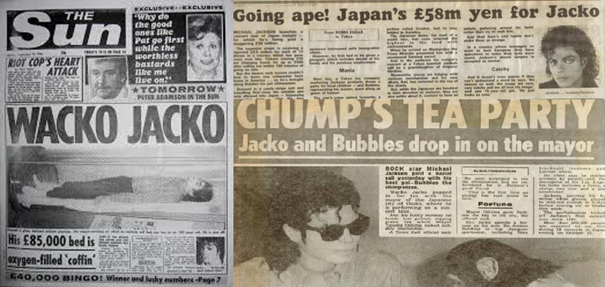
Commenting the presence of his chimpanzee Bubbles on his first solo tour in 1987, a tabloid titled „Chump’s tea party“. Hard not to see any reference to the Chimp’s tea parties organized by the London Zoo until the 1960s. From the first concert, the Bad tour was qualified by a tabloid as “the weirdest show on earth”; another one commented it “[was] going ape”, precising how much money Japan was spending “to see Jacko”. Michael Jackson’s rivalry with fellow artist Prince was described as a “gorilla warfare”, featuring the (very innocent) insertion of Bubbles between the two. When Michael Jackson sent an open letter urging the press to “walk two moons in his moccasins before judging him”, the British tabloid The Sun – the first one to use the nickname Wacko Jacko – purposely added spelling mistakes. Numerous press covers reduced him to some circus animal over the years: “Michael Jackson’s flying circus” (1987); “A day in the park with Jacko” (2003); “Daddy’s clowning” (2009). It’s his fault! He shouldn’t be that eccentric! came as a justification : after all, no one forced him to have a monkey as a pet, sleep in an oxygen chamber or retreat in some fantasy world! Michael Jackson may have had his own responsibility in his public perception to some degree, one should wonder to what extent the eccentricities of his fellow artists (Elvis Presley, David Bowie, Freddie Mercury, Elton John, etc…) were submitted to the same kind of media treatment. Whatever the circumstances behind the oxygene chamber story were, could Michael Jackson have known that this famous photo of him would be the starting point of multiple fake news feeding the “Wacko Jacko” narrative over three decades?
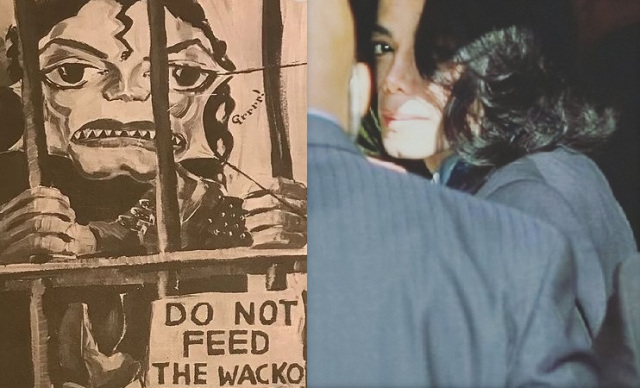
Already in the late 1980s’, the media pushed the narrative of a bizarre creature whose “abnormality” – especially his physical evolution – could only be explained by madness. Thus, the British magazine News Musical Express portrays him in 1991 as a dangerous beast disfigured by plastic surgery. Instruction on the cage: „Do not feed the Wacko“… As his skin got lighter, the medias began to speculate that he was bleaching himself in order to eradicate his ethnic origins: since he already had changed the shape of his nose, he was surely ashamed of his Black heritage, right? If Michael Jackson admitted in a 1992 private conversation that he did not want to look like his father (who called him „big nose“ when he was young), he always made it clear he was proud to be born as a Black-American. His musical inspirations were Black-American artists (James Brown, Jackie Wilson, Motown music); the overwhelming majority of his musical staff was composed of Black Americans; most actors in his music videos were Black Americans. Remember the time, directed by the late John Singleton, even portrays Egyptian royalty with an entire cast composed of Black people. When Michael Jackson revealed in 1993 that he was suffering from a skin disorder called vitiligo, his claims were received with skepticism. There could be only one explanation to his drastic physical transformation: plastic surgery. The skin disorder was officially confirmed by various pictures, the autopsy report and the testimony of multiple witnesses during the AEG trial. Many other factors were largely ignored : the lupus diagnosis, an autoimmune disease causing facial redness, lung inflammation, insomnia, premature hair loss, and extreme sensitivity to the sun; a pyrotechnic incident on the set of a Pepsi commercial in 1984 that left him with severe burns on his skull; the collapse of a bridge on which he was dancing during a charity show in 1999, which triggered his addiction to painkillers because of serious back problems; regular weight losses due to the intense pressure on tour; the use of various artifices (umbrella, mask, glove, wigs, heavy makeup,…) in order to combine artistic expression with practical dissimulation. As for the media, a lot of them interpreted these transformations as the physical manifestation of a dangerous mental unbalance, if not an indication of an underlying monstrosity.

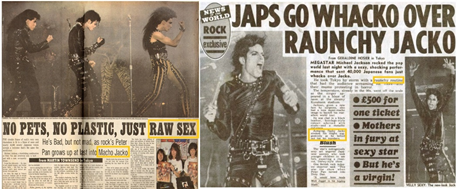
Long before any allegation, the medias also developed an all-out obsession on his sexuality : on his virginal man-child side, surely the sign of some sexual impotence ; his androgynous appearance, surely a give away of some hidden sexual orientation ; on his so called bestial attitude, surely a manifestation of some primitive sexuality. Comment by the Sun in an article titled No animals, no plastic, just raw sex : „Jumpy, flashy Jacko stroke his thighs suggestively as he belted out his hit numbers“…This obsession was largely relayed by the main media outlets whose journalists asked questions showing a rare level of indecency, very well illustrated by the attitude of Oprah Winfrey who asked him out of the blue in 1993 – because she “just wanna know” – whether he was still a virgin and years later questioned – all smile – his ex-wife Lisa-Marie Presley: “was it a consummated marriage?”. What about the (disgusted) face expression of journalist Diane Sawyer asking Lisa Marie Presley why on earth she had married Michael Jackson, not even hiding the true reasons behind her disbelief at the answers: “In love?”; “Sexual attraction, sexual attraction?”; “What about the way he looks?”; “So there were like romantic nights?”. Or the jokes of Howard Stern & co who dared asking her how she had not been disturbed by his appearance and whether she had been sexually satisfied during their marriage : “What is it that’s different about Michael Jackson’s penis that distinguishes it? Is it a vagina not a penis?”. Barely wasn’t „Jacko“ publicly blamed for being a parvenu who had stolen the crown by seducing the King’s daughter. Comment by Dee Presley (Elvis’ stepmother) expressing her concern for the „future of the Presley dynasty“ in an appearance on Diane Dimond’s Hard Copy (while having no contact with the Presleys for years): “I would like to tell Michael that there was only one King…and that was Elvis Presley”. Despite her confirmation interview after interview that her feelings were real, that there was no marriage arrangement, that she would never have married to cover anything, Lisa Marie Presley faced similar comments deshumanizing her ex-husband. Trashy behaviors worth of the lynch mob in the Elephant Man whom he confided in an 1987 interview that he felt an affinity with. Like John Merrick screaming at the crowd “I am not an animal: I am a human being”, he tried (in vain) to reassert his humanity in a 1997 interview: “You should not say he is an animal! You should not say: he’s Jacko. I’m not a Jacko: I’m Jackson!”
„Wacko Jacko“ had an Achilles Heel: his relationship with children. More than 2000 journalists – most of them working on behalf of tabloids – were accredited to follow day after day the twists of the Arvizo trial in 2005. If it was supposed to unearth the alleged dark side of the King of Pop, it was “one the most shameful episodes in journalistic history” as demonstrated by investigative journalist Charles Thompson. Shameful by the unethical methods of journalist Martin Bashir who abused Michael Jackson’s trust in order to obtain explosive revelations for his documentary. Shameful by the propensity of the media to spread the claims of the prosecution witnesses without pointing out their inconsistencies and the absurdity of the timeline despite the cross-examination. Shameful by the indulgence of the media towards the prosecutor Tom Sneddon – aka „Mad Dog“ – who ordered searches in places not covered by the warrants during the surprise raids at Neverland. Taking note of the presence of heterosexual erotic magazines in Michael Jackson’s room (combined with the absence of child pornography), he tried to prove their criminal use by the presence of the accuser’s fingerprint on them. It was without counting on the inquisitiveness of one Grand Jury member who dared asking as the child was given the magazine: “But, shouldn’t that boy be wearing gloves?”. Even less on the defense attorney Tom Mesereau who proved that the magazine in question had been published months after the last visit of the accuser at Neverland. Shameful also by the attitude of numerous (mostly white) journalists who had declared Michael Jackson guilty and barely hid their disappointment once he was acquitted by a popular jury after 5 months of a pretty absurd trial. Barely hours after showing – all smile – the inside of his future cell, Court TV anchorwoman Nancy Grace immediately jumped on the celebrity factor at the announcement of the verdict, only to have that argument refuted by the jurors in an interview on ABC morning the day after. Comment on the Arvizo case by Associated Press Correspondent Linda Deutsch, one of the rare journalists to have covered the case fairly: „A debacle that should never have been trialed„.

Nevermind, “Jacko” must have been guilty in another case, if not in that one. From a Black man to a circus animal, from a crazy monkey to a primitive beast, why not a monster harming little children behind closed doors? After all, he had agreed to settle the CIVIL trial of the Chandler case in 1994. It was omitted that the father of the child had initially proposed an arrangement behind closed doors : if Michael Jackson did not pay the amount requested, he would face public allegations. When he refused to pay, the blackmail was put into execution. That the singer settled after months of a judicial fight during which he tried to postpone the CIVIL trial in order to preserve his right to testify for the first time within the framework of a CRIMINAL trial: the settlement was concluded in order to prevent the prosecution from having access to the defense arguments in case of any future CRIMINAL trial. That in the USA, the overwhelming majority of CIVIL lawsuits end up in an amicable settlement without constituting an admission of guilt: Michael Jackson could have lose much more under constant bad publicity generated by several years of procedure. That independently of the settlement, two Grand Jury were summoned by the same prosecutor Tom Sneddon : neither of them indicted Michael Jackson based on the deposition of the child, the depositions of hundreds witnesses, the lack of incriminating evidences from the Neverland raid and the photos taken by the police during the strip body search (including pictures of the genitals). That the settlement did not prevent the Chandler family from going on with the criminal proceedings or testifying in any criminal case against him. Once the money from the CIVIL settlement was obtained, the family showed no interest in sending Michael Jackson to jail. When the prosecutor ordered Jordan Chandler to testify at the Arvizo trial, the latter replied that he would fight it by all possible legal mean. To this day, he still hasn’t come forward in support of the current accusers despite the #MeToo era. Peter Pan or Pervert? That is the question whose answer was anticipated by the medias regardless of the wobbliness of both cases. As a result, almost three-quarters of American respondents were convinced of Michael Jackson’s guilt in a poll taking place after his acquittal. It had to take his death on June 25th 2009 for Martin Bashir to finally admit that he had never seen any wrongdoing, for Diane Sawyer to wonder whether there was any medical reasons behind his eccentric accessories, for Oprah Winfrey to lament (a hand on her heart) a considerable loss. „If he dies, sympathize“ sang Michael Jackson in Tabloid Junkie…

The mourning time did not stop the tabloids from speculating on his death, publishing his autopsy photos and spreading even more fake news. The FBI files released in 2013 led to no compromising discovery ? Nevermind, the files show that “Jacko” abused 24 children according to Sunday people; 35 millions of dollar was spent to silence dozens of boys according to the Daily Mail; the police found images of child pornography and animal torture according to Radar Online. Alive or dead, Michael Jackson was also the target of numerous extortion attempts (about fifty a year according to his friend David Nordhal): a man demanding a paternity test in 2014 ; a woman claiming he was the biological father of her baby in 2015; another person claiming he saw his ghost. In the middle of these numerous claims, the breaking news of a double civil complaint in 2013 for child sexual abuse had no big echo, especially given the fact that the justice threw out each of both complaints twice. This was before the Me Too wave would shake the small world of Hollywood in 2018 with the fall of producer Harvey Weinstein and several sexual predators whose actions had been passed over for decades by the show business and the medias. Over was the time when Barbara Walters could publicly blame former child star Corey Feldman for „damaging an entire industry“ as he tried in 2013 to warn (in vain) that pedophilia was the #1 problem in Hollywood, that he was surrounded by sharks all his childhood… and that his former friend Michael Jackson was the only one who had never taken advantage of him. Surfing on the MeToo wave, Dan Reed’s Leaving Neverland premiered the same day as Ursula McFarlane’s Untouchable on Harvey Weinstein at the Sundance festival, Weinstein having allegedly abused one of his hundred alleged victims at the same festival in 1999 and Untouchable highlighting the role of the corporate medias in protecting him . Twitter world went wild as a carefully selected audience shared their shock after the screening: “powerful”, “disturbing”, “devastating”. “You haven’t seen the movie” was the common (if not identical) answer to the skeptics. A standing ovation was given to the director and the two accusers, James Safechuck and Wade Robson: „You’re going to do more good to this world than Michael fucking Jackson“ commented a reporter at the press conference.

Not surprisingly, the same medias that had „convicted“ Michael Jackson during the previous cases took the allegations for granted. We had told you “Jacko” was guilty! The influential Oprah Winfrey – who had praised Michael Jackson before the first allegations, sharply criticized him during the Arvizo case, paid a vibrant tribute to him after his death and praised him while interviewing all his closed ones – celebrated her birthday watching Leaving Neverland on David Geffen’s yacht and dedicated a special after its broadcast by HBO : “It’s time to say goodbye to Michael Jackson one last time” did she instruct in her magazine. There was a succession of calls for boycott in radio stations in several countries (Canada, New Zealand,…), Starbuck, Louis Vuitton, Spotify, etc. On Twitter, Michael Jackson fans – who knew the content of the allegations from legal documents since 2013 – tried to make the medias and the public aware of the existence of major inconsistencies in the testimonies. While standing by the presumption of innocence, I decided to wait for my own viewing of the documentary to confirm my first intuition based on the reading of the legal documents. What a shock to discover a totally one-sided documentary featuring 4 hours of raw testimonies with no perspective, endless drone shots filling the total absence of investigative work, shocking graphic description of sexual acts, well-chosen TV excerpts to “explain” both previous cases, all smile accusers contradicting their own testimonies and a final half-hour of pure pathos. Special mention to Wade Robson for comparing Michael Jackson’s hair to a brillo pad…I watched with equal dismay the overwhelming majority of journalists blatantly ignoring the calls by ordinary citizens to factcheck the allegations (what they are supposed to be paid for) instead of taking them for granted. Since Leaving Neverland defends the thesis that Michael Jackson was a manipulator who had groomed the world with his „Peter Pan“ image, his supporters could only be a mass of fanatics still under his spell: paid bots, truthers, stans, trolls, psychos, “piece of s***”, “off the wall”. It was ignoring that the tenacity of his closed ones and fans to defend his presumption of innocence had nothing to do with any blind cult of personality and that taking a stand against Leaving Neverland went far beyond defending the honor of one single man. Not to mention the diversity of people who stood up against the media approval of the „documentary“ regardless of age, nationality, skin color, profession, victim status or the depth of the connection to Michael Jackson…

If some people were willing to research both sides, I remained sometimes speechless while reading the comments and realizing the bad faith of many Leaving Neverland supporters, some crying over “harassment” after giving their public opinion on Michael Jackson. A (blue tick) Pulitzer Prize-winning photographer answering „Cute that Facebook is the source of your research“ to a person posting the link to the FBI files. A (blue tick) award-winning anti-rape activist denigrating the same documents, tweeting that „the FBI is made of people who lie, so“ but denouncing weeks later a “still racist entity […] that hasn’t faced the reality of its legacy”. So the FBI is still a racist entity in 2019 but lied to protect the most famous Black man in America decades ago, dear W.W ? A (blue tick) writer expressing anger at former child star Macaulay Culkin who testified in favor of Michael Jackson at the Arvizo trial. Angry for what, A.C. ? Not being molested ? Strange arguments to justify his guilt: “Michael Jackson pinches his lips while talking about children. I am disgusted”; “Unless I get solid proof of Michael f****** grown adult women, I’m not buying it. Bring me evidences”; I don’t care what the courts said. Michael Jackson was a child molester and he got away with it”. Various tweets reinterpreting the lyrics of his songs, not even bothering whether he wrote them or not: “Was Michael Jackson singing Ben to a rat or a little boy?”; “Man in the Mirror is terrifying when you realize that it’s him begging himself to stop, resolving to do so and knowing it only got worse”; “Jacko admitted being a paedo. He even said this himself many times. He was a bad man. He dedicated an entire album to being bad and even called it Bad. If that’s not proof, I don’t know what is”. Other dubious comments : “Isn’t it weird that the lighter Michael Jackson’s skin got, the darker his crimes became?”; “Hard to believe that a dark in the glow skeleton who dressed like Napoleon and lived in an abandoned amusement park with other people’s children and a feral chimp could have such dark side” ; “Stills blows my mind anyone thinks MJ fathered children”. Or people calling him (Wacko) Jacko for the fun to call him (Wacko) Jacko: “One thing I will absolutely NOT do is mention Michael Jackson without referring to him multiple times as Wacko Jacko”.

My dismay reached its peak when both Twitter user @MJJrepository and biographer Mike Smallcombe unearthed evidences proving a major inconsistency in the claim of each accuser. In Leaving Neverland, Wade Robson claims to have been molested for the first time as his family left him under the care of Michael Jackson at Neverland in order to travel to the Grand Canyon for five days. This claim is contradicted by his own mother’s testimonies since she confirmed both in her 1993 and 2016 depositions that her entire family was part of the Grand Canyon trip. In his legal documents, in his BBC interview and in the “documentary”, James Safechuck claims to have been abused over a period of four years, from 10 to 14 years (1988 – 1992). It was proven – building permits, aerial photos and vintage videos as evidences – that the Neverland train station in which he claims to have been abused regularly from the early time was actually built…in 1994! Reaction of the director Dan Reed who rushed to defend his protege with the worst bad-faith argument I had ever seen : „Yeah, there seems to be no doubt about the station date. The date they have wrong is the end of abuse“…The same Dan Reed had claimed a few days earlier that Michael Jackson was only interested in prepubescent boys under 14 as a response to Aaron Carter defending him because he wasn’t abused as he hung out with him at the age of 15…The same Dan Reed had also claimed in numerous interviews that he had found no single inconsistency after 18 month of research. The same Dan Reed also allegedly got busted a few days after the „trainstationgate“ with a troll account dedicated to trash Michael Jackson: @therealmjstory. As he changed the photo profile of his official account, he apparently uploaded the photo profile of the troll account before realizing his mistake a few minutes later. Although @therealmjstory vehemently denied being Dan Reed in disguise, the quick evolution of the account left few doubt in my mind. Not to mention that Dan Reed obviously responded from this account to decline an invitation to debate on Leaving Neverland with senior columnist John Ziegler. The account in question got suspended for violation of the Twitter rules in a matter of days…

Rare were the media to relay these information and denounce the attitude of the director after giving such a complacent promotion to its “documentary”. It was without counting on a handful of indomitable journalists who had refused to follow the trend blindly, starting with senior columnist John Ziegler who was the first American journalist to point out red flags after watching the documentary and analyzing legal documents: “the Wade Robson story is a complete joke in a ridiculously one-sided movie”. He was also the one to interview Brandi Jackson (Michael Jackson’s niece) and sound engineer Kevin Lipsey who both hold key information contradicting Wade Robson’s narrative while the main media outlets refused to let them tell their version. On the British side, journalist Piers Morgan was the first one to put (an obviously annoyed) Dan Reed under tough questioning and criticize his fellow journalists for their lack of challenging. In France, the media didn’t behave much better. Let’s remind that M6 didn’t lose any time to buy the rights of Leaving Neverland in order to broadcast this “documentaire-évènement” under the (sensationalist) title of Michael Jackson: the voices of the victims. It took a lot of criticisms on social networks and about 70 complaints to the High Council for Broadcasting to bring M6 to respect the presumption of innocence by picking up a more neutral title. Not to mention the complacent attitude of the journalists in the French TV show Cavous, especially the comment by the columnist analyzing the movie in front of Dan Reed : “To sum it up, we hadn’t realized that Bambi had a pecker”. Apart from overtly pro Jackson journalists (Charles Thompson, Mike Smallcombe, Olivier Cachin, Ika Ferrer Gotic…), few random journalists bothered to question the credibility of Leaving Neverland although it was blatantly one-sided, got pretty low audience shares and was generally not endorsed by random viewers despite its pushy promotion by the medias and numerous blue ticks. As for Oprah Winfrey, she maintained her full support to the documentary : if any victim had to justify the timeline of the abuse, none would ever be considered credible. After all, it doesn’t matter whether it happened on a Thursday or a Friday, right? Was it supposed to be the contribution of Leaving Neverland to the #MeToo era : to allow any alleged victim to be believed in any circumstances even in the most inexplicable ones, while offering the opportunity to Oprah Winfrey to position herself as the protector of alleged victims of sexual abuse (despite her former closeness with Harvey Weinstein)? Confronted with harsh criticism on social networks, she has since dedicated a special to the documentary “When they see us” about the Central Park 5 case…five young Black-Americans falsely convicted for the rape of a New-Yorker jogger as the result of the relentlessness of a zealous prosecutor, the police and the media. Meanwhile, we’re still waiting for the national broadcast (and the TV special) of Ursula McFarlane’s Untouchable six months after its premiere at the Sundance festival.

Nothing was spared to Michael Jackson with all due respect to all people jumping on the celebrity factor and rushing to condemn him without even trying understand his complexity. Doesn’t it matter that being raised in such a sheltering environment as the biggest child celebrity, he might have developed serious struggles to adjust his public behavior to societal norms ? Doesn’t it matter that the overwhelming majority of those who actually knew him – many of them as children – confirm they keep unforgettable memories of him without one shred of reprehensible behavior ? Doesn’t it matter that many accounts confirm the genuineness of his generosity from an early age, the number of hospitals he visited, the amount of time he dedicated to sick children, the money he spent to help the others ? Doesn’t it matter that in 2019 his humanity is still shred into pieces by racist, sexist, transphobic or simply mean comments because the “Wacko Jacko” narrative has been allowed for decades? Regarding the allegations, these are the conclusions of a lawyer after an analysis of all the cases in March 2019: „You can never ensure 100% that a man is innocent or guilty. But one thing is sure : if a jury was seized of the case today, he would acquit Michael Jackson once again„. As for me, I may not assert that I believe 100% in his innocence (contrary to those who assert they are so sure of his guilt) but I have seen enough in 6 months to convince myself of the own monstrosity of people that keep degrading the humanity of a dead man whose brother Marlon had made a wish for ten years earlier: „We would never understand what he endured. Not being able to walk across a street without a crowd around him, being judged, ridiculed. Maybe now Michael, they will leave you alone!“.

„It’s better to risk saving a guilty person than convicting an innocent one“
Voltaire
written by Marie Rousseau / translation by @Dom10155252
To go further:
Media Monkey Business around Michael Jackson’s Bad Tour by Helena (@vindicatemj)
Leaving Neverland – The Aftermath by Jin Chohan (@jin_chohan)
Neverland Firsthand – Investigating the Michael Jackson documentary by Liam McEwan (@LiamMcEwan)
Interview of John Ziegler (@Zigmanfreund) by Ika Ferrer Gotic (@IkaFerrerGotic)
Interview of psychologist Dieter Speck on Michael Jackson’s profile
The Michael Jackson Allegations

Les 25 juin 2009, le monde découvrait avec stupeur la disparition du Roi de la Pop, Michael Jackson. N’ayant pas grandi dans le culte de sa musique, je ne me souviens guère de ce jour qui ne fût en rien particulier dans ma jeune vie. A l’exception du baby-dangling, des polémiques sur sa supposée pédophilie et des circonstances mystérieuses entourant de sa mort, je ne connaissais guère l’artiste, son oeuvre et encore moins son héritage humanitaire. Pour moi, il resta dans les années qui suivirent une figure mystérieuse dont j’écoutais les titres les plus emblématiques à la radio. Ma curiosité fût piquée sur le tard, à l’occasion des célébrations de son 60ème anniversaire. Après quelques recherches j’en vins à apprécier l’homme et l’artiste, sans pour autant me considèrer comme fan de sa musique ou faire des recherches approfondies. Dans mon esprit, il avait été acquitté dans le cadre d’un procès en 2005. Aucune raison de remettre en cause cela…jusqu’au 25 janvier 2019 lorsque le documentaire Leaving Neverland fit l’effet d’une bombe au festival Sundance. Défendant farouchement le principe de la présomption d’innocence, j’étais malgrè tout disposée à croire que les accusations étaient crédibles au vu de la large approbation du documentaire par les premiers télespectateurs. Pour autant, je fus rapidement surprise par l’absence de tout questionnement sceptique par les médias mais surtout par la bassesse de nombreux arguments avancés contre Michael Jackson par ses détraqueurs : sur son physique, sur son état mental, sur ses excentricités, etc…Je constatais une vague d’articles le surnommant (Wacko) Jacko, surnom repris en coeur par nombre d’internautes sur les réseaux sociaux. Bien peu semblaient conscients – ou peut-être choisissaient d’ignorer – que le surnom prend racine dans l’histoire d’un singe accrobate nommé Jacco Maccacco, exhibé durant des combats d’animaux à Westminster dans les années 1820. Je découvris que Jacko fût utilisé pour désigner de nombreux singes depuis le XIXème siècle : des singes de compagnies (le singe accompagnant l’expédition Franklin en Antartique en 1845), des singes au coeur de légendes urbaines (ex: le „canular Jacko“ dans les années 1880), des singes dans des contes pour enfants (ex: Jumpo & Jacko Kynkytail: les drôles d’enfants-singe dans les années 1910), des singes dans des jeux pour enfants (ex: la poupée vintage Jacko le singe par Chad Valley dans les années 60), etc… Aussi, la réminiscence des articles de presse gratifiant Michael Jackson du surnom de Jacko prit-t-elle une résonnance bien étrange dans mon esprit. Pure coincidence ?

Profitant de la présence du chimpanzé Bubbles sur sa première tournée solo en 1987, un tabloid titre « Chump’s tea party ». Difficile de n’y voir aucune référence aux goûters pour singes organisés par le zoo de Londres au début des années 1920. Dés le premier concert, la tournée est décrite par un tabloid comme « le show le plus bizarre sur terre » (weirdest show on Earth). Un autre commente que la « tournée Bad vire au singe» (Bad tour going ape). La rivalité de Michael Jackson avec le chanteur Prince est qualifiée de « guerre de gorille » (gorilla warfare), avec l’insertion (innocente) du chimpanzé entre les deux. Lorsque Michael Jackson adresse une lettre ouverte, le tabloid britannique The Sun – à l’origine du surnom Wacko Jacko – rajoute des fautes d’orthographe. De nombreux articles de presse le réduisirent au fil des années à un animal de cirque : « Le cirque volant de Michael Jackson » (Michael Jackson’s flying circus); « Un jour au parc avec Jacko » (A day in the park with Jacko ; « Jacko fait le clown » (Jacko’s clowning). La faute à ses excentricités se défendirent ses détraqueurs. Après tout, personne ne l’obligeait à avoir un singe pour animal de compagnie, à dormir dans un caisson à oxygène ou à se réfugier dans un monde imaginaire. Si Michael Jackson ne fût pas complètement innocent dans la perception de son personnage public, on est en droit de se demander si les excentricités de ses confrères Elvis Presley, David Bowie ou encore Freddie Mercury firent l’objet d’une telle fixation médiatique. Pouvait-il se douter que la fameuse photo dans le caisson à oxygéne serait le point de départ d’une narrative sur la base de laquelle les médias s’autoriseraient à faire circuler de fausses informations sur son compte ?

De fait, les médias poussèrent la narrative d’une créature bizarre dont l’anormalité ne pouvait s’expliquer que par la folie. Ainsi, le magazine britannique News Week Express le caricature sous les traits d’un singe dangereux. Instruction sur la cage : « Ne pas nourrir le Bargeot » („Do not feed the Wacko“). On spécula qu’il se blanchissait la peau pour éradiquer ses origines ethniques : puisqu’il avait changé la forme de son nez, c’est bien qu’il avait honte de son héritage. Si Michael Jackson reconnut en privé ne pas vouloir ressembler à son père (qui le surnommait « gros nez »), il réaffirma toujours sa fierté d’être né Noir-Américain dans un pays encore fortement marqué par la ségrégation lorsqu’il s’imposa comme Roi de la Pop. Ses sources d’inspiration musicales étaient des artistes Noirs-Américains (James Brown, Jackie Wilson, les artistes Motown) ; la plupart des acteurs dans ses clips étaient des Noirs-Américains; l’écrasante majorité de son staff fût toujours composée de Noirs-Américains Lorsqu’il révéla en 1993 être atteint d’une maladie dépigmentant sa peau (le vitiligo), ses propos furent accueillis avec scepticisme. Il ne pouvait y avoir qu’une seule explication à ses transformations physiques : la chirurgie esthétique. On ignora largement la réalité de nombreux autres facteurs : le lupus, maladie auto-immune se manifestant par des rougeurs aux visage, des inflammations pulmonaires, des problémes d’insomnie, la perte prématurée des cheveux et une extrême sensibilité au soleil ; un incident pyrotechnique sur le tournage d’une pub en 1984, qui le laissa en partie chauve après de graves brûlures au crâne ; l’effondrement d’une passerelle sur laquelle il dansait en 1999, qui précipita son addiction aux anti-douleurs à cause de sérieux problèmes de dos ; les pertes de poids vertigineuses en raison du rythme intense des tournées ; l’usage de divers artifices (ombrelle, masque, gant, perruques, maquillage lourd, etc…) pour allier expression stylistique à dissimulation pratique. Les médias, eux, virent essentiellement dans ces transformations les manifestations physiques d’un déséquilibre mental.

Parallèlement, on développa une fixation touts azimut sur sa sexualité : sur son côté homme-enfant virginal, qui devait cacher une impotence ; sur son aspect androgyne qui devait trahir une orientation sexuelle cachée ; sur son attitude bestiale, qui devait traduire une nature primaire. Commentaire du Sun dans un article titré « Pas d’animaux, pas de chirurgie plastique, juste du sexe à l’état brut » : « Agité, le tapageur Jacko se caressa les cuisses suggestivement en beuglant ses titres phares » („Jumpy, flashy Jacko strocked his thighs suggestively as he belted out his hit numbers“). Cette fixation fût largement relayée par les principaux médias dont les journaliste posèrent des questions d’une rare indécence. En témoigne l’attitude d’Oprah Winfrey qui lui demanda de but en blanc en 1993 si « par simple curiosité » il était encore vierge et questionna son ex-épouse Lisa-Marie Presley devant un public hilare : « était-ce un mariage consommé ? ». Que dire de la mine (dégoutée) de la journaliste Diane Sawyer qui lui demanda ce qu’il lui avait pris de d’épouser Michael Jackson, ne cherchant même pas à cacher son incrédulité face aux réponses : « Vous étiez vraiment amoureuse ? » ; « Vous éprouviez vraiment de l’attraction sexuelle ? » ; « Mais, et son apparence physique ? ». Ou encore des moqueries de l’animateur radio Howard Stern et sa bande qui osèrent lui demander si elle était sexuellement satisfaite, ajoutant un magnifique « vous pouvez nous dire s’il a un vagin à la place du pénis ». Tout juste ne reprocha t-on pas à ce Noir-Américain sorti d’un guetto de l’Indiana d’être un parvenu indigne d’être le futur père des potentiels petit-enfants du King. L’intéressée eut beau confirmer d’interview en interview que ses sentiments pour lui furent réels, qu’il ne fût jamais question de marriage de convenance, qu’elle ne l’aurait jamais épousé pour couvrir quoi que ce soit, elle se heurta à l’incrédulité de ses interlocuteurs . Des commentaires dignes d’un remake de la Belle & Bête, du Bossu de Notre-Dame ou même de l’Homme-Elephant avec lequel Michael Jackson confiait dès 1987 ressentir une affinité. Tel John Merrick hurlant à un attroupement de curieux « Je ne suis pas un animal : je suis un être-humain », il tenta vainement de réaffirmer son humanité dans une interview de 1997 : « Vous ne devriez pas dire que c’est un animal ! Vous ne devriez pas dire : c’est Jacko. Je ne suis pas un Jacko : je suis Jackson! »

Animal de cirque, singe fou, bête primaire, « Wacko Jacko » devait bien avoir un Talon d’Achille : il semblait un peu trop proche des mineurs. Plus de 2000 journalistes – la plupart travaillant pour le compte de tabloids – furent accrédités pour suivre jour aprés jour les péripéties du procès Arvizo en 2005. Censé mettre en lumière le côté sombre du Roi de la Pop, il fut en réalité l’ « un des épisodes les plus honteux de l’histoire journalistique » selon le journaliste d’investigation Charles Thompson. Honteux de par les méthodes peu éthiques du journaliste Martin Bashir qui abusa de la confiance de Michael Jackson pour soutirer des révélations explosives dans le cadre de son documentaire. Honteux de par la propension des médias à rapporter les dires des témoins de l’accusation sans pointer leur absence de crédibilité pourtant démontrée lors des contre-interrogatoires. Honteux de par l’indulgence des médias face à l’acharnement du procureur Tom Sneddon – au doux surnom de « Mad Dog » (le chien enragé) – qui ordonna des perquisitions dans des endroits non-couverts par les mandats lors de raids-surprise à Neverland. Bien embêté de constater la présence de magazines érotiques hétérosexuels combiné à l’absence de matériel pédopornographique, il tenta d’en prouver leur usage criminel par la présence d’empreinte de l’enfant. C’était sans compter sur la perspicacité d’un membre du Grand Jury qui, le voyant remettre un magazine entre les mains de l’enfant, se risqua à demander : « Mais, ce gamin ne devrait-il pas porter de gants ? ». Encore moins sur celle de l’avocat de la défense Tom Mesereau qui prouva que le magazine en question avait été publié des mois après la dernière venue de l’enfant à Neverland. Au terme d’un procès absurde de cinq mois, Michael Jackson fût acquitté par un jury populaire, à la déception (visible) de nombreux journalistes. Quelques heures à peine après avoir montré – grand sourire aux lèvres – l’intérieur de sa future prison, la présentatrice Nancy Grace invoqua immédiatement le facteur célébrité à l’annonce du verdict. Commentaire de l’expérimentée reporter de cour Linda Deutsch, rare journaliste à avoir couvert l’affaire de manière impartiale : « Une débâcle qui n’aurait jamais dû aller au procès ».

Qu’importe, « Wacko Jacko » devait bien être coupable puisqu’il avait accepté un arrangement à l’amiable pour clôre le procès CIVIL de l’affaire Chandler en 1994. Les médias « oublièrent » de préciser que le père de l’enfant avait initialement proposé un arrangement en catimini avant que l’affaire éclate : s’il ne payait pas la somme demandée, Michael Jackson serait accusé publiquement. Lorsqu’il refusa, le chantage fut mis à exécution. Que le chanteur ne céda qu’au terme d’une bataille judiciaire durant laquelle il tenta de différer le procés CIVIL pour préserver son droit à donner sa version des faits pour la première fois dans le cadre d’un procès CRIMINEL : l’arrangement fût conclu afin d’eviter que la partie civile n’ait accès aux arguments de la défense en cas de futur procès CRIMINEL. Qu’aux Etats-Unis, l’écrasante majorité des procès CIVILS se termine par un règlement à l’amiable sans pour autant constituer un aveu de culpabilité : Michael Jackson risquait de perdre bien plus gros en raison de la mauvaise publicité générée par une procédure de plusieurs années. Qu’indépendemment du règlement à l’amiable, deux Grands Jury furent convoqués par le procureur Tom Sneddon pour analyser séparément les éléments à charge : aucun des deux n’inculpa Michael Jackson après étude de la version des faits de l’enfant, des dépositions de centaines de témoins, de l’absence d’éléments compromettants après deux raids-surprises, des photos prises par la police lors d’une fouille au corps sur sa personne (avec clichés des parties génitales). Que le règlement n’empêchait pas la famille Chandler de maintenir les poursuites pénales et de témoigner contre lui dans le cadre de toute autre affaire le concernant : une fois l’argent du procès CIVIL obtenu, ils ne manifestèrent aucun intérêt à envoyer Michael Jackson en prison. Lorsque le procureur enjoignit Jordan Chandler de témoigner contre lui au procès Arvizo de 2005, ce dernier répondit qu’il combattrait cette obligation par tous les moyens légaux possibles. Peter Pan ou Pervers, telle est la question dont les médias avaient anticipé la réponse, peu importe la bancalité de la première affaire et l’absurdité de la seconde. Résultat : presque 3/4 des sondés américains persuadés de la culpabilité de Michael Jackson même après l’acquittement. Il fallut attendre le 25 juin 2009 pour que Martin Bashir reconnaisse enfin qu’il n’avait jamais observé aucun comportement inapproprié, que Diane Sawyer s’interroge sur les raisons médicales de ses accessoires excentriques, qu’Oprah Winfrey déplore la main sur le coeur une perte considérable. « S’il meurt, sympathisez » chantait Michael Jackson de facon prémonitoire dans Tabloid Junkie.

Le temps du deuil n’arrêta pas la presse à scandale de spéculer sur sa mort, publier ses photos d’autopsie et faire circuler toujours plus de fake news, aucune loi ne permettant de porter plainte pour protéger la mémoire d’un défunt aux Etats-Unis. Les rapports du FBI rendus publics en 2013 montrent que les investigations n’ont débouché sur aucune découverte compromettante ? Qu’a cela ne tienne, Jacko aurait abusé 24 enfants d’après ces documents, la police aurait trouvé des images de torture d’animaux lors des raids, de nombreuses victimes auraient été payés pour leur silence, etc…Vivant ou mort, Michael Jackson fût la cible de nombreuses tentatives d’extortions (une cinquantaine par an selon son ami David Nordhal): un homme exigea un test de filiation, une femme clama qu’il était le père biologique de son bébé, un autre affirma même avoir été attaqué par son fantôme, etc…Aussi la nouvelle d’une double plainte civile en 2013 pour actes pédophiles ne résonna-t-elle pas particulièrement fort au milieu des folles rumeurs sur feu „Wacko Jacko“, d’autant que la justice rejeta chacune des deux plaintes à deux reprises. C’était sans compter sur la vague MeToo dont les accusations en cascade en 2018 allaient bouleverser le petit monde d’Hollywood avec la chute du producteur Harvey Weinstein et de nombreux prédateurs sexuels dont les agissements avaient été passés sous silence par le show business et les médias pendant des décennies. Il était fini le temps oú la journaliste Barbara Walters pouvait reprocher à l’ex-enfant-star Corey Feldman d’« endommager une industrie toute entière » lorsqu’il tenta vainement d’alerter en 2013 que la pédophilie était le problème n°1 à Hollywood… et que som ami Michael Jackson fût bien le seul à ne jamais avoir abusé de lui. Surfant sur la vague MeToo, Leaving Neverland de Dan Reed fit l’effet du bombe au festival Sundance , éclipsant la diffusion le jour même du documentaire Intouchable sur les frasques d’Harvey Weinstein, qui aurait abusé l’une de ses centaines de victimes supposées lors de ce fameux festival en 1999. La Twittosphère s’emballa lorsque les télespectateurs – triés sur le volet – partagèrent leur choc à la sortie de la projection. „Vous n’avez pas vu le film“ répondit-on (à l’identique) aux sceptiques. On réserva une standing ovation au réalisateur et aux deux accusateurs, James Safechuck et Wade Robson: „Vous allez faire plus de bien au monde que Michael fucking Jackson“ commenta un journaliste lors de la conférence de presse.

Sans grande surprise, les médias anglo-américains prirent les accusations pour argent comptant et encensèrent le documentaire. On vous l’avait bien dit qu’il était coupable! L’influente (présidentiable) Oprah Winfrey qui avait encensé Michael Jackson avant les premières accusations, l’avait vertement critiqué lors de la second affaire, lui avait rendu un hommage vibrant à sa mort, avait fait des pieds et des mains pour interviewer ses proches par la suite, dédia une spéciale au film après sa diffusion sur HBO pour soutenir la crédibilité des accusateurs: „Il est temps de dire au revoir à Michael Jackson une bonne fois pour toute lu-t-on dans son magazine. On assista à une succession de boycotts dans les radios de plusieurs pays (Canada, Nouvelle-Zélande, etc…), Starbuck, Louis Vuitton, Spotify, etc… Sur Twitter, les fans de Michael Jackson, ayant étudié les dossiers des accusateurs dés 2013, tentèrent d’alerter sur l’existence d’incohérences majeures dans les témoignages. Tout en privilégiant la présomption d’innocence, je décidais d’attendre le visionnage du documentaire pour conforter mon intuition à la lecture des documents juridique. Quelle ne fût pas mon choc de découvrir 4 heures de témoignages bruts croisant les expériences des 2 familles, d’interminables images aériennes meublant l’absence total de travail d’investigation, des descriptions sexuelles particulièrement graphiques, des extraits TV biens choisis pour « expliquer » les précédentes affaires, des accusateurs tout sourire à l’exception d’une dernière demi-heure de pure pathos… Sans parler de la comparaison (pour le moins douteuse) de la rugosité des cheveux de Michael Jackson avec celle d’une éponge à gratter. J’observai avec consternation l’écrasante majorité des journalistes ignorer purement et simplement les appels par de simples citoyens à faire leur travail de vérification des informations. Puisque le documentaire montrait Michael Jackson sous le jour d’un manipulateur ayant ensorcelé avec son image de „Peter Pan“ humanitaire, ses défenseurs ne pouvaient être qu’une horde de fanatiques encore sous le charme. C’était ignorer que la tenacité des fans à défendre la présomption d’innocence de leur idole n’avait rien à voir avec un aveugle culte de la personalité. C’était ignorer que prendre position contre Leaving Neverland dépassait largement l’enjeu de défendre l’honneur d’un seul homme. C’était ignorer la diversité des gens qui s’élevèrent contre l’approbation médiatique du „documentaire“ indépendemment de l’âge, de la nationalité, de la couleur de peau, de la profession, du statut de victime d’abus, du lien avec Michael Jackson…

Si certaines personnes se montrèrent ouvertes à rechercher les deux côtés, je restais parfois sans voix face aux commentaires, à l’argumentaire et à la mauvais foi de nombreux supporters du film. Une journaliste récompensée du prix Pulitzer répondant „Mignon que Facebook soit la source de vos recherches“ à une personne lui postant le lien vers les dossiers du FBI. Une activiste récompensée pour sa lutte contre les violences sexuelles dénigrant ces mêmes documents sous prétexte que “ le FBI est composé de gens qui mentent, donc…“. Ce Twitto déclarant „Michael Jackson était une mauvaise personne. Il a dédié un album tout entier á cela. Si cela ne constitue pas une preuve, je ne sais pas ce que c’est“. Cet autre Twitto : „Michael Jackson se pince les lèvre en parlant des enfants. Je suis dégoûté“. Un autre : „N’est-ce pas étrange que plus la peau de Michael Jackson devint blanche, plus ses crimes devinrent sombres?“. Ou ce Twitto qui enjoignit ses followers à cliquer sur le hashtag #IKnewLeavingNeverlandwasBS pour savoir combien de personnes seraient prêtes à abandonner leurs enfant à un pédophile…avant de reconnaître qu’il n’avait même pas vu le documentaire. Ma consternation atteint son pic lorsque lorsque le biographe Mike Smallcombe révéla preuve en main que chacun des accusateurs avait menti sur un élément majeur de leur témoignage. Tant dans ses documents juridiques, que dans ses interviews et dans le film, James Safechuck affirme avoir été abusé sur une période de 4 ans, de 10 à 14 ans (1988 – 1992). Il fût démontré – permis de construire, photos aériennes et vidéos d’époque à l’appui – que la station de train de Neverland dans laquelle il affirme avoir été abusé régulièrement fût construite…en 1994. Réaction du réalisateur Dan Reed qui s’empressa de voler au secours de son protégé…qui lui resta d’un silence de marbre : „Oui, il semblerait qu’il n’y ait pas de doute sur la date de la station. La date qui est fausse, c’est celle de la fin des abus“. Le même Dan Reed affirmait pourtant quelques jours plus tôt dans une interview que Michael Jackson ne s’intéressait qu’aux enfants prépubères de moins de 14 ans…pour contrer un ancien proche de Michael Jackson affirmant que rien ne lui était arrivé lorsqu’il trainait avec lui à l’âge de 15 ans. Afin de sauver la crédibilité des abus commis dans la station de train, le réalisateur était donc prêt à contredire le témoignage de son protégé et remetre en cause toute la narrative de son film avec des arguments de mauvaise foi.

Rares furent les médias à relayer l’information et dénoncer l’attitude du réalisateur après avoir accordé une promotion aussi mielleuse au film. C’était sans compter sur une poignée d’irréductibles journalistes qui avaient refusé de suivre aveuglément la tendance, à commencer par John Ziegler qui fût le premier journaliste (et le seul côté américain) à tirer la sonnette d’alarme après visionnage du documentaire et analyse des documents juridiques: «l’histoire de Wade Robson est une farce totale dans un film ridiculement unilatéral ». Côté britanique, le journaliste Piers Morgan fût le premier à demander des comptes à un Dan Reed visiblement surpris et agacé par l’attitude non complaisante de son interlocuteur…et critiqua sur Twitter l’absence de tout recul critique de la part de ses confrères journalistes. En France, nos chers médias ne se comportèrent guère mieux. Rappelons qu’M6 s’empressa d’acheter les droits de diffusion de ce „documentaire-évènement“, le renommant au passagee « Michael Jackson : la parole des victimes ». Il fallu le dépôt de quelques 70 plaintes au Conseil Supérieur de l’Audiovisuel et l’appel pour que la chaîne daigne choisir un titre plus neutre. Que dire également de l’attitude complaisante des journalistes de Cavous face à Dan Reed, en particulier le magnifique commentaire de la chroniqueuse Marion Ruggieri : « Finalement, on n’avait pas vu que Bambi avait un zizi ». Dans ce paysage médiatique, bien peu de journalistes – en dehors de ceux qui étaient déjà pro Jackson (Charles Thomson, Olivier Cachin) – ne prirent la peine de vérifier la crédibilité d’un documentaire pourtant unilatéral. Quant à l’influente Oprah Winfrey, elle signa et persista son soutien aux accusateurs : si toute victime devait justifier la timeline de ses abus, aucune ne pourrait être considérée comme crédible. Tout l’enjeu autour de Leaving Neverland était donc là: permettre à n’importe quelle victime supposée d’être percue comme crédible en toutes circonstances…sur le dos d’un homme célèbre mort pour lequel son frère Marlon avait émis un souhait dix ans plus tôt: „Peut-être que maintenant Michael, ils te laisseront enfin tranquille!“. Dans le même temps, La même Oprah Winfrey tenta de redorer son blason face à la ténacité des critiques en accordant une spéciale au documentaire When they see us sur cinq jeunes Noirs-Américains faussement condamnés pour le viol d’une joggeuse new-yorkaise…à cause de l’acharnement d’une procureure zélée, des autorités policiéres et des médias.

Rien ne fût épargné à Michael Jackson, n’en déplaise à ceux qui invoquèrent le facteur célébrité et s’empressèrent de le condamner sans jamais chercher à le comprendre . Peu importe que l’écrasante majorité de ceux qui l’ont effectivement connu – dont de nombreux enfants – confirment garder de lui des souvenirs inoubliables sans l’once d’un comportement répréhensible. Qu’importe également toutes ces vies qui furent sauvées ou allégées par sa générosité: tout au long de son existence, il dédia pas moins de 400 millions de dollar à des oeuvres humanitaires, visita de nombreux hôpitaux en marge de ses obligations, paya les soins de nombreux enfants malades. Auteur-compositeur, chanter, danseur mais aussi dessinateur, poète et lecteur avide à ses heures perdues, il revendiquait de „s’inspirer des Grands pour devenir encore plus grand“ (Leonard de Vinci, Michel-Ange, Charlie Chaplin, Walt Disney, James Brown). Dévastée à l’annonce de sa mort, son ex-épouse confia que rien chez lui ne s’apparentait de près ou de loin à la médiocrité: trop brillant pour des détraqueurs trop médiocres le „Jacko“? Dans son acharnement, la meute médiatique ignora que le monstre qu’elle voulait voir était un être-humain, qui – meurtri – finit par quitter Neverland pour de bon après la fin du procès. Conclusion du cabinet de Maître Noémie Houchet-Tran après analyse des quatre affaires en mars 2019 : « On ne peut jamais assurer à 100% qu’un homme est innocent ou coupable. Mais une chose est sûre : si un juré était saisi du dossier aujourd’hui, il acquitterait encore Michael Jackson ».
„Il vaut mieux se hasarder à acquitter un coupable que de condamner un innocent“.
Francois-Marie Arouet, dit Voltaire

Pour aller plus loin:
Leaving Neverland – The Aftermath: documentaire de @jin_n_t0nic analysant les accusations deLeaving Neverland
Podcast de John Ziegler (@Zigmanfreund) sur les incohérences de Leaving Neverland
This is an example post, originally published as part of Blogging University. Enroll in one of our ten programs, and start your blog right.
You’re going to publish a post today. Don’t worry about how your blog looks. Don’t worry if you haven’t given it a name yet, or you’re feeling overwhelmed. Just click the “New Post” button, and tell us why you’re here.
Why do this?
The post can be short or long, a personal intro to your life or a bloggy mission statement, a manifesto for the future or a simple outline of your the types of things you hope to publish.
To help you get started, here are a few questions:
You’re not locked into any of this; one of the wonderful things about blogs is how they constantly evolve as we learn, grow, and interact with one another — but it’s good to know where and why you started, and articulating your goals may just give you a few other post ideas.
Can’t think how to get started? Just write the first thing that pops into your head. Anne Lamott, author of a book on writing we love, says that you need to give yourself permission to write a “crappy first draft”. Anne makes a great point — just start writing, and worry about editing it later.
When you’re ready to publish, give your post three to five tags that describe your blog’s focus — writing, photography, fiction, parenting, food, cars, movies, sports, whatever. These tags will help others who care about your topics find you in the Reader. Make sure one of the tags is “zerotohero,” so other new bloggers can find you, too.

 Titel der Website